
R21xx-HP FlexFabric 11900 MPLS Configuration Guide

204
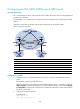
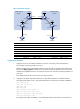
Figure 56 Network diagram
Device Interface IP
address
Device
Interface IP address
CE 1 Vlan-int12 2001:1::1/96 CE 2 Vlan-int12 2001:2::1/96
PE 1 Loop0 1.1.1.9/32
PE 2
Loop0
4.4.4.9/32
Vlan-int12 2001:1::2/96
Vlan-int12 2001:2::2/96
Vlan-int11 172.1.1.2/24 Vlan-int11 162.1.1.2/24
A
SBR-PE 1 Loop0 2.2.2.9/32
A
SBR-PE 2
Loop0
3.3.3.9/32
Vlan-int11 172.1.1.1/24
Vlan-int11 162.1.1.1/24
Vlan-int12 2002:1::1/96 Vlan-int12 2002:1::2/96
Configuration procedure
1. Configure an IGP on each MPLS backbone to ensure IP connectivity within the backbone:
This example uses OSPF. (Details not shown.)
After the configurations, each ASBR PE and the PE in the same AS can establish OSPF adjacencies.
Execute the display ospf peer command. The output shows that the adjacencies are in Full state,
and that PE and ASBR PE routers in the same AS can learn the routes to the loopback interfaces of
each other.
Each ASBR PE and the PE in the same AS can ping each other.
2. Configure basic MPLS and enable MPLS LDP on each MPLS backbone to establish LDP LSPs:
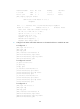
# Configure basic MPLS on PE 1, and enable MPLS LDP for the interface connected to ASBR-PE 1.
<PE1> system-view
[PE1] mpls lsr-id 1.1.1.9
[PE1] mpls ldp
[PE1-ldp] quit
[PE1] interface vlan-interface 11
[PE1-Vlan-interface11] mpls enable
[PE1-Vlan-interface11] mpls ldp enable
[PE1-Vlan-interface11] quit
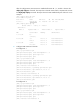
# Configure basic MPLS on ASBR-PE 1, and enable MPLS LDP for the interface connected to PE 1.
Loop0 Loop0
Loop0 Loop0
Vlan-int12
CE 1 CE 2
AS 65001 AS 65002
PE 1
PE 2
ASBR-PE 2
ASBR-PE 1
MPLS backbone
MPLS backbone
AS 100
AS 200
Vlan-int12
Vlan-int12
Vlan-int12
Vlan-int11
Vlan-int11
Vlan-int12Vlan-int12
Vlan-int11
Vlan-int11