
R21xx-HP FlexFabric 11900 MPLS Configuration Guide


263
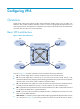
PW full mesh and split horizon
A loop prevention protocol such as STP is required in a Layer 2 network to avoid loops. However,
deploying a loop prevention protocol on PEs brings management and maintenance difficulties. Therefore,
VPLS uses the following methods to prevent loops:
• Full mesh—Every two PEs in a VPLS instance must establish a PW to create a full mesh of PWs
among PEs in the VPLS instance.
• Split horizon—A PE does not forward packets received from a PW to any other PW in the same VSI
but only forwards those packets to ACs.
PE dual homing
If only one PW is available between two CEs, the CEs cannot reach each other when the PW fails.
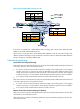
PW dual homing provides two PWs between CEs, as shown in Figure 73. T
he CEs communicate with
each other through the primary PW. When the primary PW fails, PE 1 uses the backup PW to forward
packets from CE 1 to CE 2. After CE 2 receives the packets from CE 1, CE 2 updates the MAC entry so
the packets from CE 2 to CE 1 are also forwarded through the backup PW.
Figure 73 PE dual homing
VPLS uses the backup U-PW if one of the following conditions exists:
• The tunnel over which the primary PW is established is deleted, causing the primary PW to go
down.
• BFD detects that the primary PW fails.
• The primary PW is deleted by the control plane because the LDP session between the PEs on the
primary PW is down.
• A primary/backup PW switchover is manually performed.
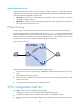
VPLS configuration task list
To configure a VPLS network, complete the following tasks:
• Configure an IGP to ensure IP connectivity within the backbone network.
• Configure basic MPLS or LDP to establish public tunnels on the backbone network.
• Configure VPLS on PEs. For example, configure a VSI, establish a PW, and associate an AC with a
VSI.