
R21xx-HP FlexFabric 11900 Network Management and Monitoring Configuration Guide

9
the device selects is called the reference source. For more information about clock selection, see the
related protocols and standards.
If the devices in a network cannot synchronize to an authoritative time source, you can select a device that
has a relatively accurate clock from the network, and use the local clock of the device as the reference
clock to synchronize other devices in the network.
Association modes
NTP supports the following association modes:
• Client/server mode
• Symmetric active/passive mode
• Broadcast mode
• Multicast mode
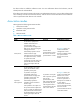
Table 1 NTP association modes
Mode Workin
g
p
rocess
Princi
p
le
A
pp
lication scenario
Client/server
On the client, specify the IP
address of the NTP server.
A client sends a clock
synchronization message to the
NTP servers. Upon receiving the
message, the servers
automatically operate in server
mode and send a reply.
If the client can be synchronized
to multiple time servers, it selects
an optimal clock and
synchronizes its local clock to the
optimal reference source after
receiving the replies from the
servers.
A client can be
synchronized to a server,
but a server cannot be
synchronized to a client.
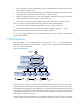
As Figure 6 shows, this
mode is intended for
configurations where
devices of a higher stratum
are synchronized to
devices with a lower
stratum.
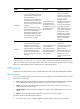
Symmetric
active/passive
On the symmetric active peer,
specify the IP address of the
symmetric passive peer.
A symmetric active peer
periodically sends clock
synchronization messages to a
symmetric passive peer. The
symmetric passive peer
automatically operates in
symmetric passive mode and
sends a reply.
If the symmetric active peer can
be synchronized to multiple time
servers, it selects an optimal clock
and synchronizes its local clock to
the optimal reference source after
receiving the replies from the
servers.
A symmetric active peer
and a symmetric passive
peer can be
synchronized to each
other. If both of them are
synchronized, the peer
with a higher stratum is
synchronized to the peer
with a lower stratum.
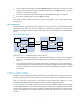
As
Figure 6 shows, this
mode is most of
ten used
between two or more
servers with the same
stratum to operate as a
backup for one another. If
a server fails to
communicate with all the
servers of a higher stratum,
the server can be
synchronized to the servers
of the same stratum.