
R21xx-HP FlexFabric 11900 Network Management and Monitoring Configuration Guide

14
• Execute the ntp-service enable command on a symmetric passive peer to enable NTP. Otherwise,
the symmetric-passive peer will not process NTP messages from a symmetric-active peer.
• Either the symmetric-active peer, or the symmetric-passive peer, or both of them must be in
synchronized state. Otherwise, their time cannot be synchronized.
• You can configure multiple symmetric-passive peers by repeating the ntp-service unicast-peer or
ntp-service ipv6 unicast-peer command.
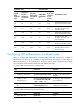
To configure a symmetric-active peer:
Ste
p
Command
Remarks
1. Enter system view. system-view N/A
2. Specify a symmetric-passive
peer for the device.
• Specify a symmetric-passive
peer:
ntp-service unicast-peer
{ ip-address | peer-name }
[ vpn-instance
vpn-instance-name ]
[ authentication-keyid keyid |
priority | source interface-type
interface-number | version
number ] *
• Specify an IPv6
symmetric-passive peer:
ntp-service ipv6 unicast-peer
{ ipv6-address | peer-name }
[ vpn-instance
vpn-instance-name ]
[ authentication-keyid keyid |
priority | source interface-type
interface-number ] *
By default, no symmetric-passive
peer is specified.
Configuring NTP in broadcast mode
A broadcast server must be synchronized by other devices or use its local clock as a reference source
before synchronizing a broadcast client. Otherwise, the broadcast client will not be synchronized to the
broadcast server.
Configure NTP in broadcast mode on both broadcast server and client.
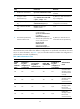
Configuring a broadcast client
Ste
p
Command
Remarks
1. Enter system view. system-view N/A
2. Enter VLAN interface view or
Layer 3 Ethernet interface
view.
interface interface-type
interface-number
Enter the interface for receiving
NTP broadcast messages.