
R21xx-HP FlexFabric 11900 Security Configuration Guide

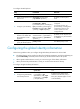

182
Ste
p
Command
Remarks
1. Enter system view.
system-view N/A
2. Create an IKE proposal and
enter its view.
ike proposal proposal-number
By default, there is an IKE
proposal that is used as the
default IKE proposal.
3. Specify an encryption
algorithm for the IKE
proposal.
encryption-algorithm { 3des-cbc |
aes-cbc-128 | aes-cbc-192 |
aes-cbc-256 | des-cbc }
By default, an IKE proposal uses
the 56-bit DES encryption
algorithm in CBC mode in
non-FIPS mode and 128-bit AES
encryption algorithm in FIPS
mode.
4. Specify an authentication
method for the IKE proposal.
authentication-method { dsa-signature
| pre-share | rsa-signature }
By default, an IKE proposal uses
the pre-shared key authentication
method.
5. Specify an authentication
algorithm for the IKE
proposal.
• In non-FIPS mode:
authentication-algorithm { md5 |
sha }
• In FIPS mode:
authentication-algorithm sha
By default, an IKE proposal uses
the HMAC-SHA1 authentication
algorithm.
6. Specify a DH group for key
negotiation in phase 1.
dh { group1 | group14 | group2 |
group24 | group5 }
By default, group1 (the 768-bit
DH group) is used.
This command is only applicable
to non-FIPS mode. In FIPS mode,
the DH group used in key
negotiation phase 1 for an IKE
proposal is fixed to group14 (the
2048-bit Diffie-Hellman group).
7. Set the IKE SA lifetime for
the IKE proposal.
sa duration seconds
By default, the IKE SA lifetime is
86400 seconds.
Configuring an IKE keychain
Perform this task when you configure the IKE to use the pre-shared key for authentication.
Follow these guidelines when you configure an IKE keychain:
1. Two peers must be configured with the same pre-shared key to pass pre-shared key authentication.
2. You can specify the local address configured in IPsec policy or IPsec policy template view (using
the local-address command) for the IKE keychain to be applied. If no local address is configured,
specify the IP address of the interface referencing the IPsec policy.
3. You can specify a priority number for the IKE keychain. To determine the priority of an IKE
keychain:
a. The device examines the existence of the match local address command. An IKE keychain with
the match local address command configured has a higher priority.
b. If a tie exists, the device compares the priority numbers. An IKE keychain with a smaller priority
number has a higher priority.
c. If a tie still exists, the device prefers an IKE keychain configured earlier.