
R21xx-HP FlexFabric 11900 Security Configuration Guide


67
Managing public keys
Overview
This chapter describes public key management for the asymmetric key algorithms including the
Revest-Shamir-Adleman Algorithm (RSA), the Digital Signature Algorithm (DSA), and the Elliptic Curve
Digital Signature Algorithm (ECDSA).
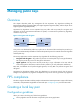
Asymmetric key algorithms use two separate keys (one public and one private) for encryption and
decryption to secure communications between two parties, in contrast to the symmetric key algorithms,
which use only one key.
Figure 21 Encryption and decryption
A key owner can distribute the public key in plain text on the network but must keep the private key in
privacy. It is mathematically infeasible to calculate the private key even if an attacker knows the algorithm
and the public key.
The security applications use the asymmetric key algorithms for the following purposes:
• Encryption and decryption—Any public key receiver can use the public key to encrypt information,
but only the private key owner can decrypt the information.
• Digital signature—The key owner uses the private key to "sign" information to be sent, and the
receiver decrypts the information with the sender's public key to verify information authenticity.
RSA, DSA, and ECDSA can all perform digital signature, but only RSA can perform encryption and
decryption.
Asymmetric key algorithms enables secure key distribution on an insecure network, but the security
strength of an asymmetric key algorithm still depends on key size as with any symmetric key algorithm.
FIPS compliance
The device supports the FIPS mode that complies with NIST FIPS 140-2 requirements. Support for features,
commands, and parameters might differ in FIPS mode (see "Configuring FIPS") and non
-FIPS mode.
Creating a local key pair
Configuration guidelines
When you create a local key pair, follow these guidelines:
• The key algorithm must be the same as required by the security application.
Receiver
Key
Plain text Cipher text Plain text
Sender
Encryption Decryption
Key