
R21xx-HP FlexFabric 11900 TRILL Configuration Guide

4
Multi-destination frame forwarding mechanism
In a TRILL network, RBs compute a distribution tree for each VLAN according to the LSDB and use the
distribution tree to guide the forwarding of multi-destination frames, which include multicast, broadcast,
and unknown unicast frames in the VLAN.
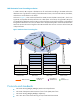
As shown in Figure 3,
when a multicast frame from VLAN 10 enters the TRILL network, RB 1, which is an
ingress RB, encapsulates the multicast frame into a TRILL frame. In the frame, the egress RB is RB 2, the
root bridge of the distribution tree for VLAN 10. When the frame arrives at the root bridge, it is distributed
throughout the distribution tree. Then, the TRILL frame is decapsulated by RB 3 and sent to the destination
station S2. Because the network segment where RB 4 resides does not have a receiver of this frame, RB
4 drops the frame.
Figure 3 Multicast frame forwarding flow
Protocols and standards
• RFC 6325: Routing Bridges (RBridges): Base Protocol Specification
• RFC 6326: Transparent Interconnection of Lots of Links (TRILL) Use of IS-IS
• RFC 6327: Routing Bridges (RBridges): Adjacency
• RFC 1195: Use of OSI IS-IS for Routing in TCP/IP and Dual Environments
VLAN 10VLAN 10
S1 S2
VLAN 200
TRILL network
RB 1
Ethernet frame
Payload
Inner VLAN = 10
Inner S-MAC = S1
Inner D-MAC = Multi
TRILL frame
Ingress RB = RB 1
Outer VLAN = 200
Egress RB = RB 2
Outer S-MAC = RB 1
Outer D-MAC = All RBs
Payload
Inner VLAN = 10
Inner S-MAC = S1
Inner D-MAC = Multi
TRILL frame
Ingress RB = RB 1
Outer VLAN = 200
Egress RB = RB 2
Outer S-MAC = RB 2
Outer D-MAC = All RBs
Payload
Inner VLAN = 10
Inner S-MAC = S1
Inner D-MAC = Multi
RB 4
RB 3
Ethernet frame
Payload
Inner VLAN = 10
Inner S-MAC = S1
Inner D-MAC = Multi
RB 2
Multicast frame
Distribution tree
of VLAN 10
Root bridge of
distribution tree
Leaf of
distribution tree