
TCP Segmentation Offload (TSO) Performance On HP rp4440 Servers Using PCI-X 2-Port Gigabit Ethernet Cards


Suggested Use
9
Technology Combinations to Use or to Be Aware Of
TSO performs differently depending on a LAN card’s design and its software driver. In
general, all of the cards supported by TSO benefit from a reduction in CPU service demand
-- those served by the iether driver and those served by the igelan driver.
Depending on your technical computing or enterprise requirements, the GigE product you
use with TSO provides the following choices:
• If you want optimum system service demand: both drivers and the cards they
support will reduce service demand.
• If you want maximum network throughput: please be aware that systems using
igelan-based cards running near network saturation will show a significant improvement
in service demand but a decrease in per card throughput. The possible reduction in
throughput on igelan based cards ranges from 2% on smaller systems to 11% on larger
systems. In this situation, systems with hardware partitioning would experience the
greatest throughput decrease.
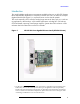
The 2-port GigE cards supported by the iether driver include the A7011A and A7012A
2-port PCI-X GigE cards and the AB352A 2-port GigE core I/O card on the rx4640 server.
The igelan driver supports A6825A copper and A6847A fiber GigE cards, the A6794A
GigE/SCSI combination card for rp7410, rp7420, and rx7620, the A7109A GigE card for
rp8420/rx8620 (either with or without IO expansion cabinet), and the GigE ports on the
A9782A/A9784A combination GigE and Fibre Channel cards.
TSO is not supported on GigE cards that use the gelan driver: the A4926A 1000Base-SX
and A4929A 1000Base-T cards.