
Compaq Parallel Database Cluster Model PDC/O1000 for Oracle8i and Windows 2000 Administrator Guide


Glossary 3
Compaq Confidential – Need to Know Required
Writer: John Blackburn Project: Compaq Parallel Database Cluster Model PDC/O1000 for Oracle8i and Windows 2000 Administrator Guide
Comments:
File Name: j-Glossary.doc Last Saved On: 6/6/01 11:49 AM
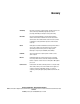
IP Address
Internet Protocol Address. An address assigned to a network
interface card, which computer entities use to locate and
communicate with each other. IP addresses can be statically or
dynamically assigned.
LAN
Local Area Network.
Load balancing
To balance the amount of work (processing) undertaken by each
node in a cluster.
NIC
Network Interface Controller. A board that allows a computer to be
connected with a network, and works with the network operating
system to control the flow of information over the network.
Node
An individual server in a cluster.
NTFS
New Technology File System. A file organization system by which
data is stored and accessed in a Microsoft Windows NT operating
system.
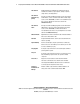
Operating
System
Dependent (OSD)
layer
A collection of low-level software modules that monitors critical
clustering hardware components and constantly transmit/receive
cluster state information to and from Oracle8i Parallel Server.
Oracle Parallel
Server Option
A software component that ships as an option of Oracle8i Enterprise
Edition. The component is responsible for enabling parallel database
support. An additional license is required for Oracle8i Parallel
Server.
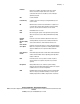
Oracle Universal
Installer
An installation application used to install and de-install both Oracle8i
software and the hardware vendor’s Operating System Dependent
modules for Oracle8i.
POST
Power-On Self-Test. A set of operations executed every time a
system is turned on to verify that components are present and
operating.
Raw partition
A disk partition that does not contain file system formatting
information. An unformatted partition. Oracle Parallel Server requires
its database files to be stored on raw partitions.
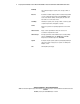
RAID
Redundant Array of Inexpensive Disks. A method of using hard disk
drives in an array to provide data redundancy to increase system
reliability and performance. RAID is categorized into several levels.