
Compaq Parallel Database Cluster Model PDC/O1000 for Oracle8i and Windows 2000 Administrator Guide
Clustering Overview 1-3
Compaq Confidential – Need to Know Required
Writer: John Blackburn Project: Compaq Parallel Database Cluster Model PDC/O1000 for Oracle8i on Windows 2000 Administrator Guide Comments:
Part Number: 225083-002 File Name: b-ch1 Clustering Overview.doc Last Saved On: 6/15/01 11:42 AM
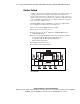
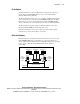
The PDC/O1000 uses non-redundant Fibre Channel Fabric Storage Area
Network (SAN) and non-redundant Fibre Channel Arbitrated Loop (FC-AL)
SAN topologies for its shared storage I/O data paths. These two SAN
topologies support the use of multiple non-redundant fabrics and loops,
respectively. In the example shown in Figure 1-1, the clustered nodes are
connected to the database on the shared storage subsystems through a
non-redundant Fibre Channel Fabric or non-redundant FC-AL. Clients access
the database through the client LAN, and the cluster nodes communicate
across an Ethernet cluster interconnect.
Availability
When computer systems experience outages, the amount of time the system is
unavailable is referred to as downtime. Downtime has several primary causes:
hardware faults, software faults, planned service, operator error, and
environmental factors. Minimizing downtime is a primary goal of a cluster.
Simply defined, availability is the measure of how well a computer system can
continuously deliver services to clients.
Availability is a system-wide endeavor. The hardware, the operating system,
and the applications must be designed for availability. Clustering requires
stability in these components, then couples them in such a way that failure of
one item does not render the system unusable. By using redundant components
and mechanisms that detect and recover from faults, clusters can greatly
increase the availability of applications critical to business operations.
Scalability
Simply defined, scalability is a computer system characteristic that enables
improved performance or throughput when supplementary hardware resources
are added. Scalable systems allow increased throughput by adding components
to an existing system without the expense of adding a new system.
In a stand-alone server configuration, scalable systems allow increased
throughput by adding processors or more memory. In a cluster configuration,
this result is usually obtained by adding cluster nodes.
Not only must the hardware benefit from additional components, but also
software must be constructed in such a way as to take advantage of the
additional processing power. Oracle8i Parallel Server distribute the workload
among the cluster nodes. As more nodes are added to the cluster, cluster-aware
applications can use the parallel features of Oracle8i Parallel Server to
distribute workload among more servers, thereby obtaining greater throughput.