
HyperFabric Configuration Guidelines

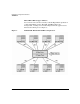









HyperFabric Configuration Guidelines
Hyper Messaging Protocol (HMP)
25
Within a cluster, ServiceGuard groups application services
(individual HP-UX processes) into packages. In the event of a single
service failure (node, network), EMS provides notification and
ServiceGuard transfers control of the package to another node in the
cluster, allowing services to remain available with minimal
interruption. ServiceGuard via EMS, directly monitors cluster nodes,
LAN interfaces, and services (the individual processes within an
application). ServiceGuard uses a heartbeat LAN to monitor the
nodes in a cluster. ServiceGuard cannot use the HyperFabric
interconnect as a heartbeat link. Instead, a separate LAN must be
used for the heartbeat.
For more information on configuring ServiceGuard, see HyperFabric
Administrator’s Guide Part Number B6257-90042, Installing and
Administering HyperFabric Part Number B6257-90030 Edition
E0601 and Managing MC/ServiceGuard Part Number B3936-90065
March 2002 Edition.
• High Availability (HA): Supported
When applications use HMP to communicate between HP 9000
nodes in a HyperFabric cluster, ServiceGuard and the EMS monitor
can be configured to identify node failure and automatically fail over
to a functioning HP 9000 node.
For more information on HA when running HMP applications,
contact your HP representative.
• Transparent Local Failover: Supported
HMP supports Transparent Local Failover in the HyperFabric
version B.11.11.03 and B.11.23.01.
When a HyperFabric resource (adapter, cable, switch or switch port)
fails in a cluster, HMP transparently fails over traffic using other
available resources. This is accomplished using card pairs, each of
which is a logical entity that comprises a pair of HF2 adapters on a
HP9000 node. Only Oracle applications can make use of the Local
Failover feature. HMP traffic can only fail over between adapters
that belong to the same card pair. Traffic does not failover if both the
adapters in a card pair fail. However, administrators do not need to
configure HF2 adapters as card pairs if TCP/UDP/IP is run over HF2
or MPI uses HMP.