
AB291A Fabric Clustering System Support Guide (12-port Switch), April 2004
Table Of Contents
- About This Document
- 1 Introduction to Technology
- 2 Hardware Overview
- 3 Installation Planning
- 4 Installing HP Fabric Clustering System
- 5 Administration and Management
- HP-UX Host Administration and Management
- Switch Administration and Management
- CLI Overview
- Using the CLI
- Advanced Switch Setup
- Configuration, Image, and Log Files
- Configuration, Image, and Log File Overview
- File Management
- Listing Configuration, Image, and Log Files
- Viewing Configuration Files
- Viewing Log Files
- Saving Configuration Files
- Saving for System Reboot
- Saving the Backup Configuration
- Specifying the Configuration to Use at
- Saving and Copying Files
- Downloading Files to the System
- Deleting Configuration, Image, and Log Files
- Managing Log Files
- Understanding the Log Format
- Uploading Log Files
- Administering the System
- 6 Monitoring and Troubleshooting
- A Specifications
- B HP 12-Port 4X Fabric Copper Switch Commands
- Show Commands
- show arp ethernet
- show arp IB
- show authentication
- show backplane
- show boot-config
- show card
- show card-inventory
- show clock
- show config
- show fan
- show host
- show ib
- show ib sm configuration
- show ib sm multicast
- show ib sm neighbor
- show ib sm node subnet-prefix
- show ib sm partition
- show ib sm port
- show ib sm service
- show ib sm switch
- show ib-agent channel-adapter
- show ib-agent summary
- show ib-agent switch
- show ib-agent switch linear-frd-info
- show ib-agent switch all mcast-info lid
- show ib-agent switch all node-info
- show ib-agent switch all pkey-info
- show ib-agent switch port-info
- show ib-agent switch sl-vl-map
- show ib-agent switch switch-info
- show interface ib
- show interface ib sm
- show interface ib sm statistics
- show interface mgmt-ethernet
- show interface mgmt-ib
- show interface mgmt-serial
- show ip
- show location
- show logging
- show ntp
- show power-supply
- show running-status
- show sensor
- show snmp
- show system-services
- show terminal
- show trace
- show user
- show version
- IP Commands
- HP Fabric Clustering System Commands
- Administrative Commands
- action
- boot-config
- broadcast
- card
- clock
- configure
- copy
- delete
- dir
- disable
- enable
- exec
- exit
- ftp-server enable
- gateway
- help
- history
- hostname
- install
- interface
- interface mgmt-ethernet
- interface mgmt-ib
- ip
- location
- login
- logging
- logout
- more
- ntp
- ping
- radius-server
- reload
- shutdown
- snmp-server
- telnet
- terminal length
- terminal time-out
- trace
- type
- username
- who
- write
- Show Commands
- C How to Use Windows HyperTerminal
- Glossary
HP 12-Port 4X Fabric Copper Switch Commands
IP Commands
Appendix B
233
Defaults:
The default is an empty string.
Related Commands:
“ip name-server-one” on page 231
“show host” on page 147
ip route
Synopsis:
The ip route configuration command defines static routes to remote hosts or networks for IP packet
forwarding.
Syntax:
ip route dest mask nexthop
no ip route dest mask nexthop
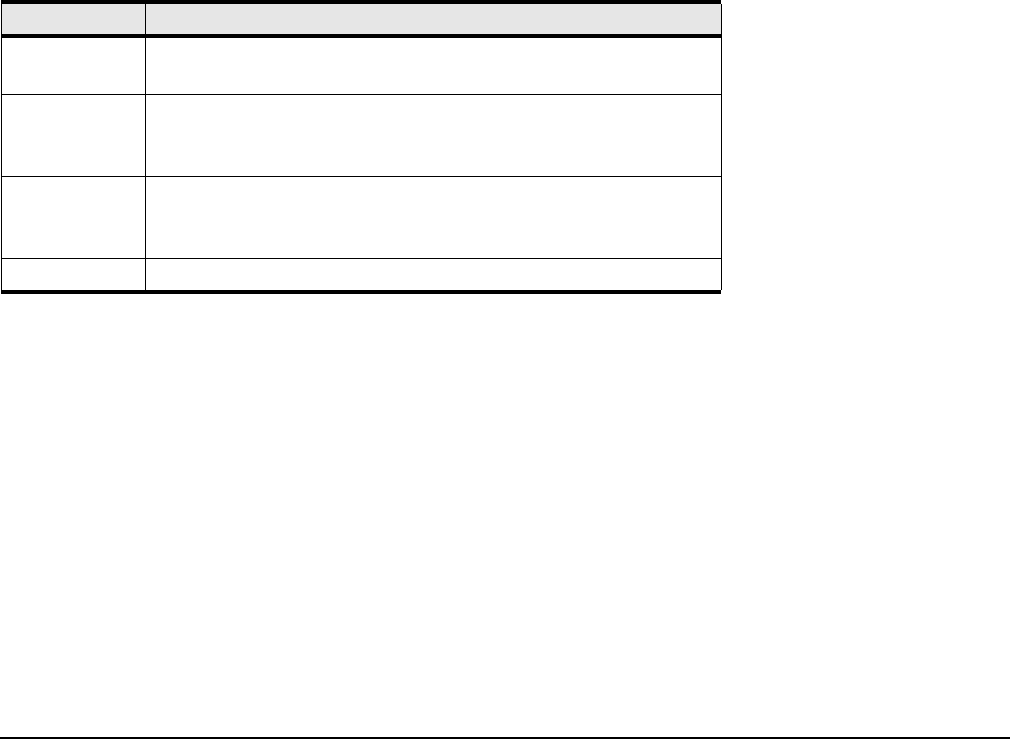
The syntax is described in the table below:
Command Modes:
Global configuration (config) mode.
Privilege Level:
Ethernet and HP Fabric read-write user.
Usage Guidelines:
This command is generally used for remote hosts without direct network access to the system fabric.
Remote routes are available across one or more routers. Routes are verified, so the specified gateway address
must be accessible. You should have no occasion to specify a local route because local routes are automatically
created when you assign an IP address to a system card or port. Some gateway functions are not supported by
HP Fabric Clustering System.
Table B-44 Command Syntax Description
Command Description
ip route Defines static routes to remote hosts or networks for IP packet
forwarding.
dest Enter the IP address of the host or network that you want to reach. The
IP address may be a network address (i.e., host bits set to zero), a host
address (i.e., non-zero host bits), or a default route (i.e., all zeros).
mask Enter the netmask used to resolve host and network addressing. The
netmask may be an IP network address, a host route (i.e.,
255.255.255.255), or the default route (i.e., 0.0.0.0.0).
no Use this keyword to remove the static route setting.