
AD386A PCIe 10 Gigabit Ethernet Card Overview

Product Overview
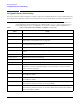
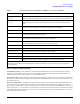
10 Gigabit Ethernet Link Settings
8
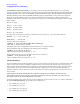
Transmit/Receive Interrupt Coalescing -- The AD386A card provides four link-utilization ranges and corresponding
interrupt coalescing timers. An interrupt will be generated by the card
after the interrupt coalescing time has elapsed. The
interrupt coalescing timer value in turn depends on the link utilization range. The link utilization ranges and the
interrupt coalescing timer value for that link utilization range
are programmable. You can specify three range limits
(Range R1, Range R2, and Range R3) that provide four utilization ranges as indicated below. Please note that the link
utilization is expressed as a percentage. Corresponding to each range, we have
interrupt coalescing timers: TIM-A, TIM-B,
TIM-C, TIM-D.
Here are the ranges:
Range-A 0 - R1% TIM-A
Range-B R1 - R2% TIM-B
Range-C R2 - R3% TIM-C
Range-D R3 - 100% TIM-D
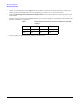
The timer value is expressed in a granularity of 100ns and can be in the range {1 - 1000}. The default values are:
Link util : 0 - 1 1 - 10 10 - 50 50 - 100
Timer (0.1us) : 1 100 500 1000
The timer values can be changed by
lanadmin –X coal_time TIM-A TIM-B TIM-C TIM-D ppa
where: TIM-A < TIM-B < TIM-C < TIM-D.
Note that the timer values are applicable to both transmit and receive interrupt coalescing.
The link utilization ranges for transmit interrupt coalescing can be changed by
lanadmin –X tx_coal R1 R2 R3 ppa
where: R1<R2<R3 and R1, R2 and R3 are in {1 .. 99}.
The link utilization ranges for receive interrupt coalescing can be changed by
lanadmin – X rx_coal R1 R2 R3 ppa
where: R1<R2<R3 and R1, R2 and R3 are in {1 .. 99}
Checksum Offload
Checksum Offload (CKO) is enabled by default; so, there is no need to enable it explicitly. CKO is a performance feature that
reduces a system CPU’s burden by offloading computation of the TCP checksum to the network card. The transport layer
always performs checksum validation using a computed checksum regardless of whether CKO is ON or OFF. When CKO is
disabled (OFF), the transport layer will still validate checksums, computing them in the host CPU rather than using an
offloaded computation from the network card. You can turn CKO ON or OFF for the transmit side or for the receive side of
each LAN card.
Multi-fragment Checksum Offload (MF CKO) indicates whether the card computes checksum for IPv4
multi-fragment (UDP) packets. MF CKO is disabled by default for both transmit and receive path, but can be
turned ON or OFF for each path independently of the other.
To change the default setting of CKO on each specific 10 GigE LAN card, use an editor such as “vi” to edit the configuration
file /etc/rc.config.d/hpicxgbeconf. The parameters in the config file are
• HP_ICXGBE_CKO_IPV4_TX
• HP_ICXGBE_CKO_IPV4_RX
• HP_ICXGBE_CKO_IPV4_MF_TX
• HP_ICXGBE_CKO_IPV4_MF_RX