
Virtual Connect and HP A-Series switches (A5820) IRF Integration Guide

7
IRF and MAD technology overview
IRF (Intelligent Resilient Framework)
IRF
IRF creates one logical switch from two or more physical switches. The A5820 switch
can support up to nine switches in one IRF domain.
The logical switch uses standard LACP to connect to any vendor, core, distribution,
or edge switches with a failure convergence time of less than 40 milliseconds. The
switch acts as the following:
Single IP address for management
Single layer 2 switch
Single layer 3 router (all protocols)
Implementation is available across multiple products from core to access platforms
A12500, A10500 A9500, A7500, A5820, A5800, and A5500 series switches.
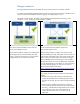
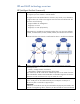
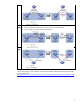
With IRF technology, the network is transformed as shown in the following diagram.
Role
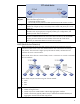
Member switches form an IRF virtual device. Each of them performs one of the
following two roles:
Master—manages the IRF virtual device
Subordinate—members that are backups of the master
If the master fails, the IRF virtual device automatically elects a new master from one
of the subordinates. Masters and subordinates are elected through the role election
mechanism. An IRF virtual device has only one master at a time.
IRF port
An IRF port is a logical port dedicated to the internal connection of an IRF virtual
device. An IRF port can be numbered as IRF-port1 or IRF-port2. An IRF port is
effective only after it is bound to a physical port.
Important:
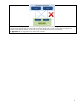
An IRF-Port1 on one device can only be connected to the physical port bound to the
IRF-Port2 of a neighboring device; otherwise, an IRF virtual device cannot be formed.