
User Guide

Your opinion matters! Visit
www.LearningResources.com
to write a product review or to
nd a store near you.
© Learning Resources, Inc., Vernon Hills, IL, US
Learning Resources Ltd., Oldmedow Road,
King’s Lynn, Norfolk PE30 4JX, UK
Please retain our address for future reference.
Made in China. LPK1211-GUD
Fabriqué en Chine. Informations à conserver.
Made in China. Bitte bewahren Sie unsere Adresse
für spätere Nachfragen auf.
Hecho en China. Conservar estos datos.
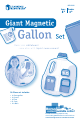
Bring measurement concepts to life with colorful magnets that resemble liquid containers
in familiar shapes. Proportionately sized pieces help students understand the relationships
between gallons, quarts, pints, and cups. Use this set to also develop conversion and fraction
skills, as shown in the following activities. Leave the mess behind and embrace a neater
brand of hands-on measurement instruction!
Simple Activities
Exploring Units
Put all the pieces on the board. Ask students to identify cups, pints, quarts, and a gallon, and
then place them in order from greatest to least volume. Next, place the pieces of each unit
over the next largest unit to demonstrate the following equivalencies (smaller pieces should
t evenly within larger pieces):
1 gallon = 4 quarts 1 quart = 2 pints 1 pint = 2 cups
Understanding Conversions
Build the entire set on the board. Start with the gallon as the background. Layer the other
pieces over the gallon to demonstrate that there are 4 quarts in a gallon, 2 pints in each
quart, and 2 cups in each pint. Then, to familiarize students with this visual cue, ask some
follow-up questions: “How many quarts are in a gallon? How many pints are in a quart? How
many cups are in a pint?” This shows students the relationships between consecutive units of
measure.
Next, guide students through conversions of non-consecutive units. Ask students to nd
how many cups are in a quart, how many pints are in a gallon, and so on. There are many
possibilities! With practice, students will be able to quickly and condently answer questions
that would otherwise be considered a challenge.
8 Ounces of Wisdom
Once students know the corresponding measurement of the smallest unit, the cup, they can
apply that knowledge to the larger units. Share with students that the cup holds 8 ounces.
Students should therefore understand, following what they learned in the previous activities,
that a pint is 16 ounces (because there are 2 cups in a pint), that quarts are 32 ounces, and so
on. If they remember the value of a cup, the other measurements will fall into place.
Liquid Fractions
Don’t forget to use this set to provide examples of real-life fractions! Put a quart piece on the
board. Place 2 pints on top of the quart, and then layer 4 cups on top of the pints. Make sure
to keep the smaller pieces within the quart’s outline to show the equivalencies. Ask students
to ll in the following blanks with the appropriate fractions.
If the quart is 1 whole, a pint is _________.
If the quart is 1 whole, a cup is _________.
Assemble the entire set on the board and ask questions relating the set to fractions. Here
are some examples: “How many cups are in ½ of a gallon? How many quarts are in ¼ of a
gallon? One cup represents what fraction of a gallon?”