
Instruction manual



Instruction Sheet
for the PASCO
Model ES-9042A
FARADAY ICE PAIL
012-04393B
11/95
$1.00
Introduction
The Ice Pail designed by Faraday is an excellent product
for sampling a charge distribution. It operates on the prin-
ciple that a charge placed inside a conducting surface will
induce an equal charge on the outside of that surface. For
example, if a charged ball were hung inside a coffee can,
the charge on the outside of the can would equal the
charge of the ball. The charge can be measured with an
electrometer such as the PASCO Model ES-9054B Stu-
dent Electrometer.
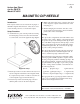
The PASCO Model
ES-9042A Faraday Ice Pail
is a wire mesh cylinder mea-
suring 10 cm in diameter by
15 cm deep with a wire
mesh bottom. It is mounted
on three insulating rods
along the outer edge of a
wire mesh shield.
The wire mesh shield not
only ensures complete vis-
ibility of the experiment but
also helps eliminate the
problem of stray charges and AC fields.
To prevent stray charges from producing erroneous re-
sults it is extremely important that the person performing
the experiment be continually grounded while performing
the experiment. The Ice-Pail needs to be temporarily
grounded prior to starting the experiment.
A charged object such as the PASCO Model ES-9057A
Charge Producers and Proof Plane is placed in the
grounded ice pail (without touching it), and the electrom-
eter indicates the potential between the ice pail and
ground. The greater the charge the greater the potential.
Thus we can easily measure relative charges by varying
the charges in the ice pail and observing the potential in-
dicated by the electrometer.
Complete instructions for the operation of PASCO Elec-
trostatic equipment can be found in the ES-9051 Acces-
sory and Demonstration Manual (included with the Dem-
onstration System) and the ES-9055 Laboratory Manual
(included with the Electrostatic Laboratory System)
Demonstration: Faraday Ice Pail and Charge
Production
Since the Faraday Ice Pail is used so frequently in electro-
static demonstrations, one should examine the relation-
ship between the charge induced on the ice pail by an in-
serted object and the actual charge on that object. Using
the ice pail, one can then investigate the nature of charging an
object by contact as opposed to charging by induction.
Equipment needed: Faraday Ice Pail, charge producing ob-
jects (such as ES-9057A Charge Producers), electrometer
Setup
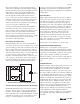
➀ Connect the electrometer input lead (red alligator clip)
to the ice pail to create a system for measuring
charge. The electrometer ground lead (black alligator
clip) attaches to the shield. (Setup is shown in Figure
1.) Adjust the sensitivity of the electrometer so that
most readings appear in the upper 2/3 of the scale.
Electrometer
Red Clip
Charge Producer
+
+
+
+
+
+
+
+
+
+
+
+
-
-
-
-
-
-
-
-
--- -
-
-
-
-
-
-
-
+
+
+
+
+
+
+
+
+
+
+
+
+
+
+
+
+
+
--
--
+
+
Figure 1
© 1993 PASCO scientific
Faraday Ice Pail
Black Clip