User's Manual The Monolith III Speaker System
Important Contents Your Martin-Logan speakers are provided with automatic Limited 90 Day Warranty coverage. Introduction 3 Installation in Brief 4 Monolith III Specifications 5 History 6 Connection 8 You have the option, at no additional charge, to receive Limited 3 Year Warranty coverage. To obtain Limited 3 Year Warranty coverage you need only complete and return the Certificate of Registration that was included with your speakers to Martin-Logan, within 30 days of purchase.
Introduction Congratulations, you have invested in one of the world’s premier loudspeaker systems! The Martin-Logan MONOLITH III represents the culmination of an intensive, dedicated group research program directed toward establishing a world class reference monitor utilizing leading-edge technology, without compromising durability, reliability, craftsmanship, or aesthetic design.
Installation in Brief We know you are eager to hear your new MONOLITH III loudspeakers, so this section is provided to allow fast and easy set up. Once you have them operational, please take the time to read, in depth, the rest of the information in this manual. It will give you perspective on how to obtain the best possible performance from this most exacting transducer.
Monolith III Specifications The MONOLITH III hybrid speaker system consists of a broad-range single element electrostatic transducer integrated with a quick-response woofer. This approach takes maximum advantage of the positive aspects that both technologies have to offer. electrostatic transducer element itself, an elegantly simple solution. Dispersion is a controlled 30 degrees.
History In the late 1800’s, any loudspeaker was considered exotic. Today, most of us take the wonders of sound reproduction for granted. and loudspeaker to take advantage of the new recording medium. Bell Labs assigned the project to two young engineers, C.W. Rice and E.W. Kellogg. It was 1880 before Thomas Edison had invented the first phonograph. This was a horn-loaded diaphragm that was excited by a playback stylus.
extremely accurate speaker, but Janszen found that the cone speakers of the period were too nonlinear in phase and amplitude response to meet his criteria. Janszen believed that electrostats were inherently more linear than cones, so he built a model using a thin plastic diaphragm treated with a conductive coating. This model confirmed Janszen's beliefs, for it exhibited remarkable phase and amplitude linearity.
Connection AC Power Connection Signal Connection Electrostatic speakers use an internal power supply to energize their electrostatic elements with high-voltage DC (low current). As such, they must be connected to an AC wall outlet. For this reason we have provided your speakers with the proper IEC standard power cords. These cords should be firmly inserted into the AC power receptacles on the rear connection panel of the speakers, then to any convenient AC wall outlet.
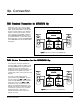
IIIp Connection ONE: Standard Connection for MONOLITH III p. IIIp Please take note of the jumpers installed across the binding posts of the IIIp INTERFACE.. These jumpers attach the high-pass and the low-pass sections of the interface together. Leaving these in place, connect the (+) wire from your amplifier to either of the red AMPLIFIER SIGNAL binding posts of the Interface and the (-) wire to either of the black posts. Next, connect the IIIp INTERFACE to the MONOLITH III with the provided cables.
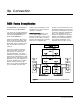
IIIp Connection THREE: Passive Bi-amplification. The MONOLITH III may be passively biamplified using the IIIp INTERFACE. You cannot use an external electronic crossover with the MONOLITH III (other than the IIIx CROSSOVER which replaces the IIIp INTERFACE)! Passive bi-amplification takes the biwiring concept one step further. Now you will have a dedicated channel of amplification directly connected to the high and low-pass sections of the crossover. outputs.
eliminate the negative effects of time delay (also referred to as group delay) that occurs when a signal passes through two dissimilar amplifiers. The very nature of vertical bi-amping dictates that both amplifiers be identical. With horizontal bi-amping bi-amping, one amplifier drives the high-pass section while the second amplifier drives the low-pass section. To horizontally biamp your Monoliths you must remove the jumpers from the AMPLIFIER SIGNAL binding postsof the IIIp INTERFACE.
IIIx Connection Introduction The MONOLITH IIIx system utilizes the electronic IIIx CROSSOVER which incorporates technology developed for our STATEMENT SYSTEM CROSSOVER. Use of the MONOLITH IIIx CROSSOVER will result in substantial improvements in all aspects of your system's performance. Bass will be more extended with more impact and control. Special bass contour controls allow you to tailor the bass response to suit your particular room environment or listening tastes.
AC PPower ower Connection Plug in AC mains only after all signal connections have been made and you have verified that both amplifiers are switched off. convenient AC wall outlet. For absolute protection, do not defeat the power plug ground. This provides powerline grounding of the MONOLITH IIIx CROSSOVER chassis and will protect you from electrical shock. We have provided your MONOLITH IIIx CROSSOVER with the proper IEC standard 3-conductor power cords with 3-prong grounding plug.
IIIx Operation Crossover Settings Before you do any formal listening, you must set a pair of switches in the crossover. However, if you are using identical amplifiers (i.e. same make and model) for the high and low-pass sections of the Monolith, you may use the factory settings and skip this step. On the back panel of the crossover there are two cut-outs that allow you to access two red dip switches.
sweeping from 100 Hz to 20 Hz and back again, and listening in different places in your room for what we call room nodes, or depressions, you can hear where the room either emphasizes certain bass frequencies or cancels them.
IIIx Operation IIIx Technical Description Musical Tastes Theory of Operation An added benefit of the contour controls on the IIIx CROSSOVER, is the ability to adjust your speaker's personality to your style of listening. The audio signal coming from the preamplifier of your audio system is typically representitive of a low impedance voltage source. There are a few preamplifiers, such as older tube designs, which may not conform to this, as they have a much higher output impedance.
The woofer has another set of requirements based upon its inherent displacement limitations. In order to recreate strong low frequency energy using a dynamic cone drive, a high “Q” driver in a large tuned (usually ported) box is required. The trade-off with this approach is poor speed, acceleration, and damping of the woofer driver.
Room Acoustics Your Room Terminology This is one of those areas that requires a little background to understand and some time and experimentation to obtain the best performance from your system. Standing Waves Waves. The parallel walls in your room will reinforce certain notes to the point that they will sound louder than the rest of the audio spectrum and cause “one note bass”, “boomy bass”, or “tubby bass”. For instance, 100Hz represents a 10' wavelength.
Rules of Thumb Bipolar Speakers and Your Room Hard vs. Soft Surfaces Surfaces. If one surface of your room (wall, floor, ceiling) is hard, a good rule of thumb suggests to try to have the opposing surface soft. So, if you have a hard wall of glass or paneling on one side of the room, it is best to have drapery or wall hangings on the opposing wall. If you have a hard ceiling, it generally is a good idea to have a soft floor of carpeting or area rugs.
Room Acoustics Dispersion Concepts In the field of loudspeaker design, it is common knowledge that as the wave becomes progressively smaller than the transducer producing it, the dispersion of that wave becomes more and more narrow, or directional. This occurs as long as the transducer is a flat surface. Historically, most attempts to achieve smooth dispersion from large flat panel transducers resulted in trade-offs.
Placement General Placement The Back Wall Start by making certain that both speakers are the same distance from the walls behind or beside them and that their “toe-in” angle is the same. At this time you may want to enlist the help of a friend or family member to assist you. Near-field reflections can also occur from your back wall. If your listening position is close to a back wall, these reflections can cause problems and confuse the quality of imaging.
Placement Experimentation Toe-in Toe-in. Now you can begin to experiment. First begin by toeing your speakers in towards the listening area and then toeing them out. You will notice that the tonal balance changes ever so slightly. You will also notice the imaging changing ever so slightly. Generally it is found that the ideal listening position is with the speakers slightly toed-in so that you are listening to the inner third of the curved transducer section.
General Information Associated Equipment Care Enjoy Yourself Your Martin-Logan Dealer was carefully selected by our company because they are knowledgeable, experienced and dedicated to musical excellence and customer satisfaction. The Martin-Logan Monolith has been carefully designed and precisely engineered. With a little care you can rest assured that they will continue to look as good as they sound for years to come.
The Electrostatic Concept How is it that music can be recreated by something that you are able to see through? Electrostatic energy makes this possible. Where the world of traditional loudspeaker technology deals with cones, domes, diaphrams, and ribbons that are moved with magnetism, the world of electrostatic loudspeakers deals with charged electrons attracting and repelling each other. To fully understand the electrostatic concept , some background information will be helpful.
major contributor to the sonic purity of the electrostatic concept due to its exceptional linearity and low distortion. Since the diaphragm of an electrostatic speaker is uniformly driven over its entire area, it can be extremely light and flexible. This allows it to be very responsive to transients, thus perfectly tracing the music signal. As a result , great delicacy, nuance and clarity is possible.
Martin-Logan Exclusives 1. Full Range Operation The most significant advantage of Martin-Logan's exclusive transducer technology reveals itself when you look at examples of other loudspeaker products on the market today. The MONOLITH III uses no crossover networks above 125 Hz because they are not needed. The MONOLITH III consists of a single, seamless electrostatic membrane reproducing all frequencies above 125 Hz simultaneously.
2. Curvilinear Line Source Since the beginning of Audio, achieving smooth dispersion has long been a problem for all loudspeaker designers. Large panel transducers present even more of a challenge because the larger the panel, the more directional the dispersion pattern becomes. Full range electrostats have long been one of the most problematic transducers because they attain their full range capabilities via a large surface area.
Questions Could my children, pets, or myself be shocked by the high-voltage present in the electrostatic panel? Should I unplug my Monoliths during a thunderstorm? Will excessive smoke or dust cause any problems? Yes. Or before. It’s a good idea to disconnect all of your audio/video components during stormy weather. Exposure to excessive smoke or dust may potentially affect the performance of the electrostatic membrane.
Troubleshooting No Output. Check that all your system components are turned on. Check your speaker wires and connections. Check all interconnecting cables. Weak Output, Loss of Highs. Check the power cord. Is it properly connected to the speaker? If you are bi-amplifiying, check your high frequency amplifier. Is it functioning properly? Exaggerated Highs, Brightness. Check the toe-in of the speakers. Read Room Placement for more information. Muddy Bass Check placement.
Glossary AC AC. Abbreviation for alternating current. Active crossover crossover. Uses active devices (transistors, IC’s, tubes) and some form of power supply to operate. Amplitude Amplitude. The extreme range of a signal. Usually measured from the average to the extreme. Arc Arc. The visible sparks generated by an electrical discharge. Bandwidth Bandwidth. The range of frequencies within a radiation band required to transmit a particular signal. Bass Bass. The lowest frequencies of sound.
value. Inductance Inductance. The property of an electric circuit by which a varying current in it produces a varying magnetic field that introduces voltages in the same circuit or in a nearby circuit. It is measured in henrys. Inductor Inductor. A device designed primarily to introduce inductance into an electric circuit. Sometimes called a choke or coil. Linearity Linearity. The extent to which any signal handling process is accomplished without amplitude distortion. Midrange Midrange.
$ 3.00 2001 delaware street, p.o. box 741, lawrence, kansas 66044, phone: 913.749.0133, fax: 913.749.5320 © 1989 Martin-Logan Ltd. All rights reserved.