
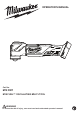
Operator's Manual



3
SERVICE
SPECIFIC SAFETY RULES FOR
MULTI-TOOL
• Hold power tool by insulated gripping surfaces,
repair person using only identical replacement
parts. This will ensure that the safety of the power
tool is maintained.
• Never service damaged battery packs. Service
of battery packs should only be performed by the
manufacturer or authorised service providers.
when performing an operation where the cutting
accessory may contact hidden wiring. Cutting ac-
cessory contacting a "live" wire may make exposed
metal parts of the power tool "live" and could give the
operator an electric shock.
• Use clamps or another practical way to secure
• When battery pack is not in use, keep it away
from other metal objects, like paper clips, coins,
keys, nails, screws or other small metal objects,
that can make a connection from one terminal
to another. Shorting the battery terminals together
• Under abusive conditions, liquid may be ejected
from the battery; avoid contact. If contact ac-
cidentally occurs, flush with water. If liquid
contacts eyes, additionally seek medical help.
Liquid ejected from the battery may cause irritation
or burns.
• Do not use a battery pack or tool that is dam-
explosion or risk of injury.
•
• Follow all charging instructions and do not charge
the battery pack or tool outside the temperature
Charging
range may damage the battery and increase the risk
and support the workpiece to a stable platform.
Holding the work by hand or against your body leaves
it unstable and may lead to loss of control.
•To reduce the risk of explosion, electric shock and
property damage, always check the work area for
hidden gas pipes, electrical wires or water pipes
when making blind or plunge cuts.
WARNING
• Keep hands away from all cutting edges and
moving parts. Do not reach underneath the
workpiece.
• Do not use dull or damaged blade, which can
cause excessive friction, blade binding and kick-
back.
• Know your workpiece. Remove nail and screw
heads before scraping. Hitting hard objects with
blade may cause the tool to kick back.
WARNING
sawing, grinding,
Some dust created by power sanding,
drilling, and other
construction activities contains chemicals known to
cause cancer, birth defects or other reproductive
harm. Some examples of these chemicals are:
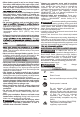
SYMBOLOGY
Volts
Direct Current
No
• lead from lead-based paint
• crystalline silica from bricks and cement and other
masonry products, and
• arsenic and chromium from chemically-treated
lumber.
Your risk from these exposures varies, depending on
how often you do this type of work. To reduce your
exposure to these chemicals: work in a well ventilated
area, and work with approved safety equipment, such
as those dust masks that are specially designed to
Do not expose a battery pack or tool to fire or
excessive temperature. Exposure to fire or
temperature above 130°C (265°F) may cause
explosion.
To reduce the risk of injury, when
working in dusty situations, wear
appropriate respiratory protection or use a
suitable dust extraction solution.
•
•
Maintain labels and nameplates. These carry
important information. If unreadable or missing,
contact a MILWAUKEE
®
service facility for a
replacement.
Always use common sense and be cautious
when using tools. It is not possible to anticipate
every situation that could result in a dangerous
outcome. Do not use this tool if you do not
understand these operating instructions or you feel
the work is beyond your capability; contact
MILWAUKEE
®
Tool or a trained professional for
additional information or training.
To reduce the risk of fire,
ADDITIONAL BATTERY SAFETY RULES
WAR
NIN
G
personal injury , and product damage due to a
short circuit, never immerse your tool, battery
pack or charger in fluid or allow a fluid to flow
inside them. Corrosive or conductive fluids,
such as seawater , certain industrial chemicals,
and bleach or bleach-containing products, etc.,
can cause a short circuit.
WAR
NIN
G
Do not charge
non-rechargeable batteries.
Do not dispose of electric tools
together with household waste
material. Electric tools and electronic
equipment that have reached the end
of their life must be collected
separately and returned to an
environmentally compatible recycling
facility.
Regulatory Compliance Mark (RCM).
This product meets applicable
regulatory requirements.
Read operator’s manual
No load oscillations per minute (OPM)
V
may exhibit unpredictable behaviour resulting in fire,