
User`s manual


145
CHAPTER 4 FUNCTION
4
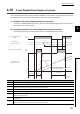
4.12 Internal Clock Function
4.12 Internal Clock Function
The internal clock function is the function that does the count by using internal clocks incorporated in the QD65PD2.
For instance, an on delay timer consists of this function and the coincidence output function.
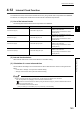
(1) List of the internal clocks
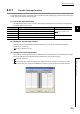
The following table lists the internal clocks incorporated in the QD65PD2.
(2) Internal clock selection
Select internal clocks in the "Count source selection" in the switch setting.
(3) Calculation of a count value and time
The formulas for calculating a count value and time in case an internal clock is used for counting are shown
below.
• Count value = Time(S) One cycle of an internal clock(s)
• Time(s) = Count value × One cycle of an internal clock(s)
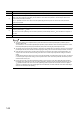
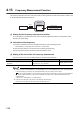
● When measuring time by using an internal clock, consider the time lag relative to the actual time.
Also, the component error (±100ppm) of each internal clock affects the time.
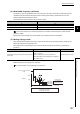
In case the count is done from 0 to 10000 by using an internal clock (0.1µs), the time calculated with the above
formula is 1ms(=(10000-0)
×0.1µs).
But the actual time becomes as shown below.
(1ms
×(1-0.0001)×(1+0.017252604)) to (1ms×(1+0.0001)×(1+0.017252604))
Name Description Remark
Internal clock (0.1µs) A clock with 0.1µs per cycle
The clock has +1.7252604% of time lag
relative to the actual time.
(The percentage is rounded off to seven
decimal places.)
Internal clock (1µs) A clock with 1µs per cycle
The clock has +0.3689236% of time lag
relative to the actual time.
(The percentage is rounded off to seven
decimal places.)
Internal clock (10µs) A clock with 10µs per cycle
The clock has -0.0379774% of time lag
relative to the actual time.
(The percentage is rounded off to seven
decimal places.)
Internal clock (100µs) A clock with 100µs per cycle
The clock has +0.0027127% of time lag
relative to the actual time.
(The percentage is rounded off to seven
decimal places.)
Ex.