
User manual



© MOBOTIX AG • Security Vision Systems • Made in Germany
www.mobotix.com • sales@mobotix.com
7/44
1.1 Two-Wire Cables
A two-wire cable is usually a two-wire copper cable whose two wires are twisted together
(twisted pair). A classic two-wire cable is an analog telephone wire with a wire diameter of
0.8 mm, which, in terms of quality (according to the ISO/IEC 11801 standard), corresponds to
a category 1 cable for voice transmission. MX2wire+ can also be operated using untwisted
cables that have at least two wires forming a physical connection between the two Mx2wire+
units. Please note that the quality, length and diameter of the two-wire cable used all have
an influence on the transfer of data and the PoE output (see Section 1.4).
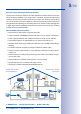
Antenna or Coaxial Cable (e.g., for an Analog Camera)
• Cable type: RG according to MIL-C-17 (coaxial cable)
• An analog camera can be easily exchanged for an IP camera
• Interference-free thanks to closed systems and cable shielding
• Range (at 40Mbps): 500 m
Analog Telephone Line Or Bell Wire (e.g., for an IP Telephone)
• Cable type: JY, A2Y and YR (telephone and low-voltage cable)
• Very good availability in buildings
• Core diameter 0.6 to 0.8mm
• Range (at 40Mbps): 300 m
Power Line (Should No Longer Be Live)
• Cable type: NY (installation cable)
• Widespread availability of cables
• Cables must be disconnected from the power supply!
• Wire cross-section max. 2.5 mm
2
• Range (at 40Mbps): 300 m
Ethernet Installation Cable (for Extending the Network)
• Cable type: Cat7 (S/FTP, 4x2xAWG 23, 1000MHz)
• Long range data and power transmission
• Range (at 40Mbps): 500 m
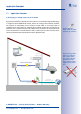
By correctly combining
or twisting additionally
available wires to form
two wires or cables, the
transmission line for
data and power can be
considerably increased