
Data Sheet



© 2011 Fairchild Semiconductor Corporation www.fairchildsemi.com
FDMF6823A • Rev. 1.0.3 12
FDMF6823A — Extra-Small, High-Performance, High-Frequency DrMOS Module
Functional Description
The FDMF6823A is a driver-plus-FET module optimized
for the synchronous buck converter topology. A single
PWM input signal is all that is required to properly drive
the high-side and the low-side MOSFETs. Each part is
capable of driving speeds up to 1 MHz.
VCIN and Disable (DISB#)
The VCIN pin is monitored by an Under-Voltage Lockout
(UVLO) circuit. When V
CIN
rises above ~3.1 V, the driver
is enabled. When V
CIN
falls below ~2.7 V, the driver is
disabled (GH, GL=0). The driver can also be disabled by
pulling the DISB# pin LOW (DISB# < V
IL_DISB
), which
holds both GL and GH LOW regardless of the PWM
input state. The driver can be enabled by raising the
DISB# pin voltage HIGH (DISB# > V
IH_DISB
).
Table 1. UVLO and Disable Logic
UVLO DISB# Driver State
0 X Disabled (GH, GL=0)
1 0 Disabled (GH, GL=0)
1 1 Enabled (see Table 2)
1 Open Disabled (GH, GL=0)
Note:
3. DISB# internal pull-down current source is 10 µA.
Thermal Warning Flag (THWN#)
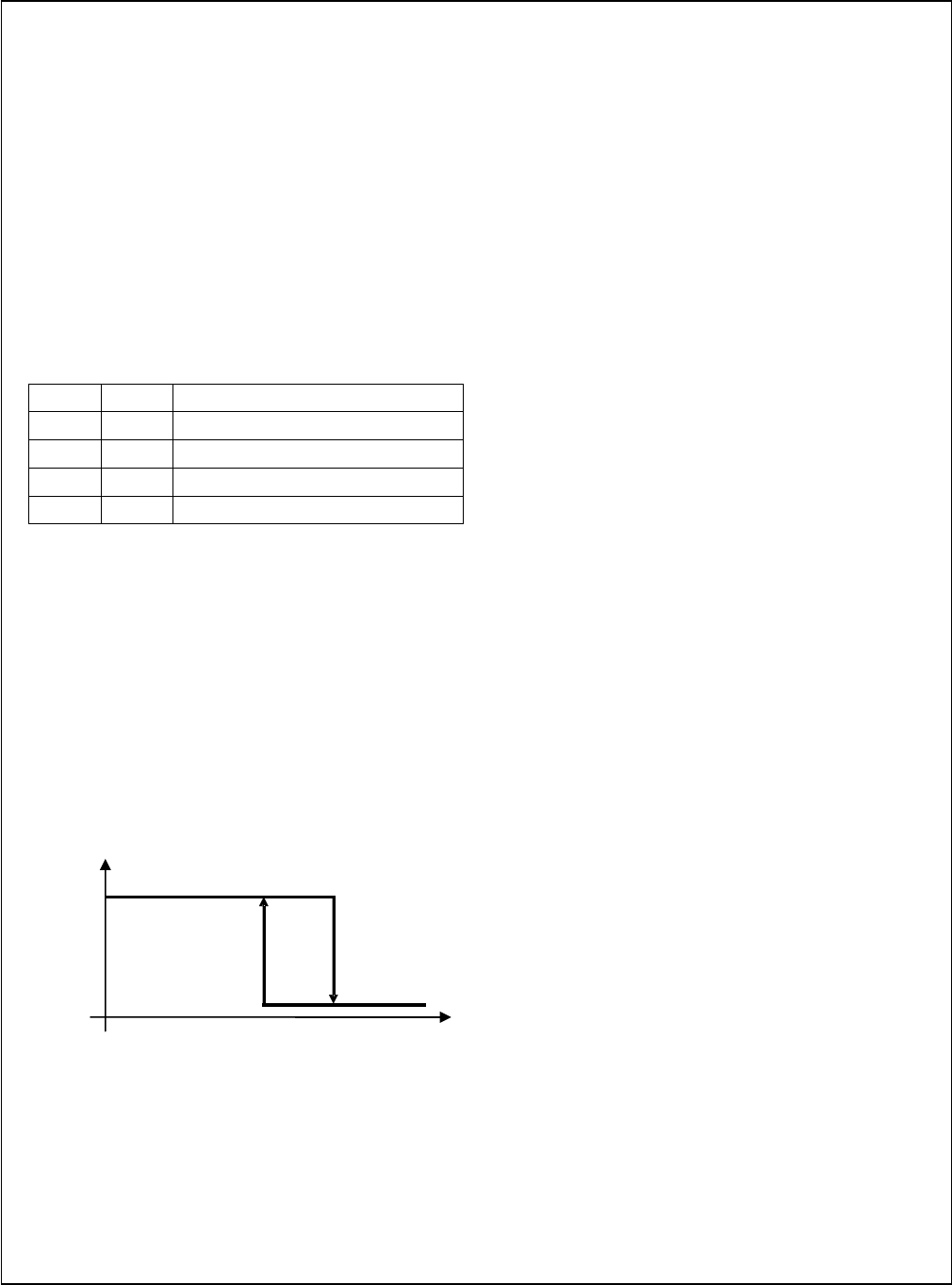
The FDMF6823A provides a thermal warning flag
(THWN#) to warn of over-temperature conditions. The
thermal warning flag uses an open-drain output that
pulls to CGND when the activation temperature (150°C)
is reached. The THWN# output returns to a high-
impedance state once the temperature falls to the reset
temperature (135°C). For use, the THWN# output
requires a pull-up resistor, which can be connected to
VCIN. THWN# does NOT disable the DrMOS module.
Figure 26. THWN Operation
Three-State PWM Input
The FDMF6823A incorporates a three-state 5 V PWM
input gate drive design. The three-state gate drive has
both logic HIGH level and LOW level, along with a
three-state shutdown window. When the PWM input
signal enters and remains within the three-state window
for a defined hold-off time (t
D_HOLD-OFF
), both GL and GH
are pulled LOW. This enables the gate drive to shut
down both high-side and low-side MOSFETs to support
features such as phase shedding, which is common on
multi-phase voltage regulators.
Exiting Three-State Condition
When exiting a valid three-state condition, the
FDMF6823A follows the PWM input command. If the
PWM input goes from three-state to LOW, the low-side
MOSFET is turned on. If the PWM input goes from
three-state to HIGH, the high-side MOSFET is turned
on. This is illustrated in Figure 27. The FDMF6823A
design allows for short propagation delays when exiting
the three-state window (see Electrical Characteristics).
Low-Side Driver
The low-side driver (GL) is designed to drive a ground-
referenced, low-R
DS(ON)
, N-channel MOSFET. The bias
for GL is internally connected between the VDRV and
CGND pins. When the driver is enabled, the driver's
output is 180° out of phase with the PWM input. When
the driver is disabled (DISB#=0 V), GL is held LOW.
High-Side Driver
The high-side driver (GH) is designed to drive a floating
N-channel MOSFET. The bias voltage for the high-side
driver is developed by a bootstrap supply circuit
consisting of the internal Schottky diode and external
bootstrap capacitor (C
BOOT
). During startup, V
SWH
is held
at PGND, allowing C
BOOT
to charge to V
DRV
through the
internal diode. When the PWM input goes HIGH, GH
begins to charge the gate of the high-side MOSFET (Q1).
During this transition, the charge is removed from C
BOOT
and delivered to the gate of Q1. As Q1 turns on, V
SWH
rises to V
IN
, forcing the BOOT pin to V
IN
+ V
BOOT
, which
provides sufficient V
GS
enhancement for Q1. To complete
the switching cycle, Q1 is turned off by pulling GH to
V
SWH
. C
BOOT
is then recharged to V
DRV
when V
SWH
falls to
PGND. GH output is in-phase with the PWM input. The
high-side gate is held LOW when the driver is disabled or
the PWM signal is held within the three-state window for
longer than the three-state hold-off time, t
D_HOLD-OFF
.
150°C
A
ctivation
Tem
p
e
r
ature
T
J_driver IC
Thermal
Warning
Normal
Operation
HIGH
LOW
135°C Reset
Temperature
THWN#
Logic
State