
Instructions





Chapter 2 Performance Verification Test Overview RIGOL
MSO5000-E Performance Verification Guide 2-9
Timebase Accuracy Test
Specification
Timebase Accuracy
[1]
Specification
≤ ±(10 ppm + Clock Drift
[2]
× Number of years that the instrument has been
used
[3]
)
Note
[1]
: Typical.
Note
[2]
: Clock drift≤ ±10 ppm/year.
Note
[3]
: For the number of years that the instrument has been used, please calculate according to the date in the
verification certificate provided when the instrument leaves factory.
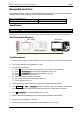
Test Connection Diagram
Figure 2-5 Timebase Accuracy Test Connection Diagram
Test Procedures
1. Connect the active head of Fluke 9500B to CH1 of the oscilloscope, as shown in the figure above.
2. Turn on Fluke 9500B; set its impedance to 1 MΩ.
3. Output a Sine with 10 MHz frequency and 1 Vpp amplitude via Fluke 9500B.
4. Configure the oscilloscope:
1) Press 1 in the vertical control area (Vertical) on the front panel to enable CH1.
2) Press 1 Attenuation to set the probe attenuation ratio to "1X".
3) Press 1 Impedance to set the input impedance to 1 MΩ.
4) Set the vertical scale to 50 mV/div.
5) Set the vertical offset to 0.
6) Set the horizontal timebase to 1 ns/div.
7) Set the horizontal position to 1 ms.
5. Observe the screen of the oscilloscope. Press Cursor Mode, then select "Manual" to enable
the manual mode of cursor measurement. Measure the offset (ΔT) of the middle point of the
signal (namely the crossing point of the rising edge of the current signal and the trigger level line)
relative to the screen center using manual cursor measurement and record the measurement
result.
6. Calculate the timebase accuracy; namely the ratio of ΔT to the horizontal position of the
oscilloscope. For example, if the offset measured is 1 ns, then the timebase accuracy is 1 ns/1
ms=1 ppm.
7. Calculate the timebase accuracy limit by using the formula ±(10 ppm + 10 ppm/year × Number of
years that the instrument has been used).
Fluke 9500B
MSO5000-E