
User guide


9
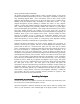
for reasons already stated. Now we move the sound source to the “left”. The signal falls
off somewhat as heard by the M microphone, but picks up at the S microphone. Because
of the electrical phase of this signal, it adds to the M signal feeding the “left” channel,
making the sound appear to be coming from the left. Signal also feeds the “right” channel,
but out of phase with respect to the M signal that also feeds the “right” channel. Thus,
while the “left” channel experiences an increase in output, the “right” channel loses signal
and this adds to the feeling that the sound source is truly at the “left.”
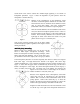
Now we move the sound source to the “right” of the SF-12. As before, signal reaching the
M microphone decreases in level, while the signal at the S microphone increases.
Remember, we are talking about a bi-directional ribbon. The phase of the sound source at
the S microphone is opposite to what it had been when the source was located at the
“left” of the microphone.
The combination of the reversed phase from the microphone and the inverted phase
feeding the “right” channel means that the signal is now in phase with the “right” portion
of the M signal. It is, however, out of phase with respect to the M signal feeding the
“left” output channel. With the increased output on the “right” channel, coupled with the
decreased output on the “left” channel, our sound source appears to be on the “right”
channel, just as it is supposed to be.
If we remove the S signal, we have pure monophonic sound. As we add more S signal,
stereo appears. If we make the level of the S signal equal to that of the M signal, we will
recreate the sound stage. If we add more S than M, we make the stage wider than life.
That might come in handy if stereo was insufficient in the live situation. If the recording
had been conventional, little could to be done to improve matters.
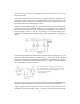
It is often helpful to make a recording with the M signal fed into the recorder left channel
and the S signal on the right channel. Later, in the calmer light of the control room, you
can connect the recorder’s outputs as you did the microphone elements in our discussion.
Not only can you determine the nature of the reproduced soundfield but you can treat the
S signal in other ways. For instance, suppose you have a disk-recording situation in
which the vertical information is such that groove lifts tend to occur. You can take the S
signal, limit it, equalize it and feed it to your mixer as described. Almost magically, the
vertical problems have vanished and the stereo effect is still excellent.
Space does not permit a fuller discussion of the M-S intensity stereo format, first
described by Alan D. Blumlein over 50 years ago. We suggest the following reading on the
subject:
W. Dooley & R. Streicher
“M-S Stereo: A Powerful Technique for working in Stereo”
J. Audio Eng. Soc., Vol. 30 pp.707 (1982 Oct.)
AA
AA
pp
pp
pp
pp
ll
ll
ii
ii
cc
cc
aa
aa
tt
tt
ii
ii
oo
oo
nn
nn
ss
ss
The SF-12 combines high quality audio performance with unbeatable stereo separation
and imaging. The microphone is housed in a trim package, free of the cluttered look