
Installation Guide

asbestos. Regulations may require that the material be tested to determine
asbestos content and may govern the removal and disposal of material. See
current edition of the Resilient Floor Covering Institute (RFCI) publication
Recommended Work Practices for Removal of Resilient Floor Coverings for
detailed information and instructions on removing all resilient covering
structures. For current information go to www.rfci.com
C. Existing Floor Coverings
• VersaLock ooring can be installed over most existing hard–surface
oor coverings, provided that the existing oor surface is clean, at dry
and structurally sound.
• Quarry tile, terrazzo and ceramic tile - Use caution with highly
embossed tile. This type of tile plus grout joints should be lled with a
high quality cementitious patching product.
• When the removal of the existing resilient oor covering is not an option
then it must be covered with an embossing levelling compound or an
equivalent in order to provide a smooth suboor surface. Otherwise,
telegraphing may occur.
• Existing sheet vinyl oors should not be heavily cushioned and not
exceed more than one layer in thickness. Soft underlayment and soft
substrates will diminish VersaLocks inherent strength in resisting
indentations.
• Installation is NOT allowed over any type of carpet.
III. INSTALLATION
VersaLock plank ooring is designed to be installed
utilizing the oating method only. Never secure the
planks to the suboor. Undercut all doorjambs. Do
not fasten wall mouldings and or transition strips to
the planks.
1. Before you start with the installation, it is
important to determine the layout of the
ooring. Proper planning and layout will
prevent having narrow plank widths at wall
junctures or very short length pieces at the end
of rows.
2. As with all plank products, install the planks
parallel to the longest exterior wall.
3. Determine if the starter row will need to be cut.
If the rst row of planks does not need to be
trimmed in width, it will be necessary to cut off
the unsupported tongue so that a clean, solid
edge shows towards the wall.
4. Installation of the product must start from the
left side of the room, working to the right when
working in front of the planks or facing the
starting wall.
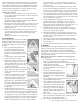
5. Install the second plank in the row by angling
the end tongue into the end groove of the
rst plank. Be careful not to bend the corner
of the plank. Maintain an expansion gap of
approximately 5/16” - 8mm from the wall. Start
the second row by cutting a plank to the desired
length. Keep in mind that the plank must not
be shorter than 6 inches (15cm) to achieve the
best appearance.
6. Install the rst plank in the second row by
inserting the long side tongue into the groove of the plank in the rst
row. This is best done with a low angle of the plank. Maintain pressure
into the side seam as you rotate the plank to the suboor. Install the
second plank in the second row by inserting the short end tongue into
the previously installed plank groove. Align the plank so that the long
side tongue tip is positioned just over the groove lip of the plank in
the rst row. Working from the end seam, at a low angle, insert the
long tongue into the groove of the adjoining plank. Very little force is
required to seat the tongue into the groove. You should feel the tongue
lock into the groove.
7. Work across the length of the room installing planks along the wall in
the rst row and then aligning the planks in the second row. It is critical
to keep these two rows straight and square, as they are the “foundation”
for the rest of the installation. Check squareness and straightness often.
8. Cut the last plank in the rst row and leave an expansion gap of around
5/16” - 8mm. Planks may be cut with a utility knife using the “score and
snap” technique. The leftover of this plank may be used to start the third
row if it’s a minimum 6” - 15cm long.
9. Continue installing planks and make sure to achieve a random
appearance with end pieces of minimum 6” - 15cm. Check that all
planks are fully engaged; if a slight gapping is found, the gap can be
tapped together by using a tapping block and a scrap of ooring to cover
the tapping block in order to avoid damages on the planks.
10. When tting under door casings, etc., the exibility and convenient
connection of VersaLock becomes evident. If necessary, a at pull bar
may be used to assist in locking the planks.
11. When tting around obstacles or into irregular spaces, planks can be
cut easily and cleanly using a utility knife with a sharp blade. It is often
benecial to make a cardboard template of the area and transfer this
pattern to the plank.
12. Protect all exposed edges of the ooring by installing wall moulding
and/or transition strips. Make sure that no plank will be secured in any
way to the sub oor.
13. Protect the nished ooring from exposure to direct sunlight.
IV. REPAIRS
VersaLock plank ooring is tough and durable; however, if a plank becomes
damaged, it can be replaced. If the damaged plank is along the perimeter
of the room, the easiest technique is to disconnect the planks until the
damaged plank is removed. Replace the plank and reassemble the planks.
If it is impractical to disconnect and reassemble the ooring, the following
procedure should be followed:
Make sure the new product is acclimated 24 to 48 hours prior the
board replacement.
1. It’s recommended to use painters tape along the sides of the board to be
replaced to prevent damage to the adjoining boards.
2. Using a Utility Knife, cut through the center of the damaged plank,
running the length of the plank.
3. Carefully remove cut pieces from the insert.
You can use a utility knife to remove the pieces
from the oor.
4. Clean up any debris from opening area.
5. To prepare replacement plank. Cut and remove
tongue from the long side and the short end of
the plank. This can be accomplished by using a
Utility knife.
6. Using a Utility Knife, remove about 1.5 inches of the groove on the long
side of the plank from the tongue end.
7. Apply a small bead of Shaw 4062 seam sealer
or use a Ethyl Cyanoacrylate adhesive (super
glue) to the groove of the boards in the oor.
8. Insert replacement plank, locking the long
side joint (groove side) into the existing oor.
NOTE: The tongue end of the replacement
plank will overlap the existing oor prior to be
fully inserted.
9. Using a scrap piece of plank as a tapping device, tap the groove end into
place. Insert the blade of a Utility knife on the opposite side to lift and
adjust the end as it is being tapped into place.
10. Place a weight on the plank until the adhesive sets.
© 0514113 Shaw Industries Group, Inc., a Berkshire Hathaway Company