
Operating instructions





Technical data
13.1 General technical data
SIPART PS2 with and without HART communications
208 Operating Instructions, 09/2008, A5E00074631-08
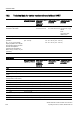
General data
• Enclosure
6D5**0-*** (plastic) Glass fiber reinforced macrolon
6DR5**1-*** (metal) GD AISi12
6DR5**2-*** (stainless steel) Austenitic stainless steel mat. no. 1.4581
6DR5**5-*** (metal, pressure resistant) GK AISi12
• Pressure gauge block
Aluminum AIMgSi, anodized
Vibration resistance
• Harmonic vibrations (sine) according to DIN EN 60062-2-
6/05.96
3.5 mm (0.14"), 2 ... 27 Hz, 3 cycles/axes
98.1 m/s² (321.84 ft/s²), 27 to 300 Hz, 3 cycles/axes
• Bump (half-sine) according to DIN EN 60068-2-29/03.95
150 m/s² (492 ft/s²), 6 ms, 1000 shocks/axle
• Noise (controlled digitally) according to DIN EN 60068-2-
64/08.95
10 ... 200 Hz; 1 (m/s²)²/Hz (3.28 (ft/s²)²/Hz)
200 ... 500 Hz; 0.3 (m/s²)²/Hz (0.98 (ft/s²)²/Hz)
4 hours/axle
• Recommended range of continuous operation of the entire
control valve
≤ 30 m/s² (98.4 ft/s²) without resonance peak
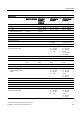
Weight, basic device
• Plastic enclosure
Approximately 0.9 kg (1.98 lb)
• Metal enclosure, aluminum
Approximately 1.3 kg (2.87 lb)
• Metal enclosure, stainless steel
Approximately 3.9 kg (8.6 lb)
• Metal housing, Ex d version
Approximately 5.2 kg (11.46 lb)
Dimensions See dimensional drawing
Climate class According to DIN EN 60721-3-4
• Storage
2
)
1K5, but -40 ... +80°C (1K5, but -40 ... +176°F)
• Shipping
2
)
2K4, but -40 ... +80°C (2K4, but -40 ... +176°F)
• Operation
3
)
4K3, but -30 ... +80°C (4K3, but -22 ... +176°F)
1
) Impact energy max. 1 joule for plastic/aluminum enclosure.
2
) Be sure that the valves have been flushed out enough with the dry medium when commissioning is at a temperature of
≤ 0°C (≤ 32 F).
3
) When the temperature is ≤ -10°C (≤ 14°F) limited repetition rate of the LCD display. When using I
y
modul, only T4 is
permissible.
Certificates and approvals
Classification according to pressure equipment
directive (PED 97/23/EC)
For fluid group 1 gases; fulfills requirements in
article 3, paragraph 3 (good engineering
practice SEP)