
Catalogue


UH-PRC002-EN 37
Sequence of Operations
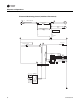
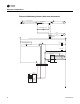
Electronic Modulating Control (with room thermostat)
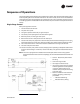
With power applied to the unit:
1. The thermostat calls for heat.
2. The pilot valve opens.
3. The ignitor sparks continuously to ignite the pilot.
4. The sensor proves pilot ignition and shuts off the ignitor.
5. With the pilot lit, the gas valve opens.
6. Main burners are lit at 100 percent of unit’s rated input.
7. The fan time delay relay (optional on duct furnaces) allows the heat exchanger to come up to
operating temperature. At this time, the fan time delay relay closes and activates the fan motor.
1
8. The unit is controlled by the electronic thermostat which modulates the unit from 100 to 50
percent of unit’s rated input. An amplifier receives a small electrical signal from the thermostat
and converts this into a working voltage. This working voltage determines the position of the
modulating valve. With no voltage applied to the valve, the valve will be full open and full fire
will occur. As increasing voltage is applied to the valve, the valve will modulate closed. At
approximately 12 Vdc, the valve will be at its minimum low fire position. If the voltage continues
to increase, indicating a further reduction in the unit’s firing is required, the increased voltage
closes a relay which closes the automatic gas valve. As temperature drops, the voltage also
drops causing the relay to re-open the valve. The unit will continue to cycle in this manner until
either an increase in the unit’s firing rate is required or the thermostat is satisfied and no longer
calls for heat.
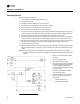
9. When the room thermostat is satisfied, the main and pilot valves close.
10. The fan time delay relay (optional on duct furnaces) remains closed keeping the fan motor
operating to dissipate residual heat from the heat exchanger. At this time, the fan time delay
relay opens and deactivates the fan motor.
1
See “Fan Control,” p. 30.