
Installation manual


INSTALLATION
10 April 2010 / W-SQ20 for mobile applications / EN
3 FUEL PIPES
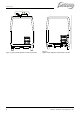
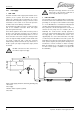
When the tank is above the generating set (figure 7) we
recommend ending the return line on the top of the tank.
When the return is on the top - in case of a leakage the
return line cannot overflow because of siphoning. One will
only need a fuel cock in the fuel supply line. When the tank
is below the generating set we recommend ending the
return line on the bottom of the tank (A) below the inlet of
the supply line.
Both supply and return fuel pipe lines should be
appropriate material and 8 mm outer diameter tubing. The
quality of the tubing of fuel pipes could be submitted to
local regulations depending on the application of the
vehicle.
The fuel pipes can be plumbed to the flexible hoses which
are on the generating set and have a connection to fit to 8
mm pipe. This fuel lines fulfils CE standards and are
according to ISO 7840 A2.
It is important to avoid bends in the pipes, as they could
trap air bubbles. The return pipe should never be
connected to the suction pipe. The return pipe should
never be connected to the suction pipe. The return line
should be of 8 mm diameter and go straight back via the
top to the bottom of the tank. When the return is too
narrow, has too many bents and goes back to the bottom
of the fuel tank, the back-pressure could be too high. This
results in irregular running of the engine. When the engine
runs irregular, one can check if back-pressure is the
problem by disconnecting the return line just outside the
canopy and draining it in a canister. When the engine runs
smooth now, the return piping has to be changed. It could
also help to install a second (electrical 12V) fuel lift pump
in the supply line to increase the pressure.
4 FUEL FILTERS
A fine fuel filter is installed which requires maintenance.
Whisper Power advises to install an extra fuel filter/ water
fuel separator near the fuel tank.
Before starting your generating set for the first time follow
the fuel system bleeding procedure in the users manual.
2.5.2 Radiator cooling
1 GENERAL INSTRUCTIONS
The radiator can be mounted below the floor, in the side or
on the roof of the vehicle. Wherever the radiator is
mounted the well functioning of the system depends on
the well circulation of the coolant. A roof mounted radiator
brings the most risk for circulation problems, because air
trapped in the radiator or a low level of the coolant, will
immediately affect the cooling capacity of the radiator. It is
recommended to keep the radiator as close as possible to
the engine. The piping should be fitted as direct as
possible.
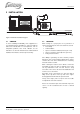
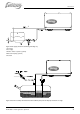
When the radiator is above the engine, the piping should
be fitted below the top of the radiator! (refer to figure 10).
Bents in the piping, that can trap air bubbles, should be
avoided or ventilated (refer to figure 11)
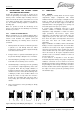
Figure 10: Air traps should be avoided
Figure 11: Ventilating an air trap
Piping should not be fitted above the radiator!
OK