
User's Manual


MPR series User’s Manual: Draft version 0.95 11/4/04 page 27
The electrical impedance presented by an antenna is a complex function of the frequency, the antenna
shape, and the near-antenna environment. Antennas are carefully designed so that the electrical impedance
of the antenna is well-matched to the impedance of the device to which they are connected. For example,
the MPR6000/7000 will generally employ a cable with 50 ohm characteristic impedance to connect the
reader to the antenna. In order for the power from the reader to be effectively transferred to the antenna,
the antenna must have an electrical impedance close to 50 ohms, with little capacitance or inductance, at
the frequency of operation. As noted previously, conductive objects or some other materials such as
aqueous liquids placed close to an antenna will change its impedance and thus degrade its match to the
cable. For best read range, keep such obstructions away from the antenna in directions of maximum
directive gain.
1.5.3.3 Tags
A UHF RFID tag typically consists of a specialized integrated circuit (IC) attached to an antenna structure
fabricated on an inexpensive flexible plastic substrate. The antenna and substrate designs vary
considerably to meet the needs of specific applications. Tags may be configured to respond primarily to
one linear polarization, to have some response to both orthogonal directions, or to provide multiple
antennas with capability for switching the IC to the best direction at any given moment.
The natural size for an antenna structure for a given wavelength l of electromagnetic radiation is about
half of the wavelength: l/2. Since the wavelength is about 33 cm at 915 MHz, the natural size for a simple
antenna is about 16 cm (6.5 inches). Half-wave antennas radiate and receive effectively, and tend to have
convenient nearly-resistive impedances: they are resonant. However, for many applications such an
antenna is excessively large. Many tags are designed with antennas that are smaller than l/2. While such
antennas may be configured to provide good impedance matching, some compromise in radiation
efficiency is inevitable: in general, smaller antennas will not perform as well as half-wavelength antennas.
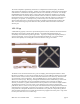
Tag antennas may be bent or curved to conserve space and allow some response to multiple linear
polarizations; however, in this case only the regions of the antenna that are along the polarization direction
contribute to the received signal, so again the received power is reduced. Note that most tag antennas are
incorporated onto a flat plastic substrate and are thus themselves in a plane; like a dipole, the tag antenna
does not transmit and cannot receive signals whose direction of propagation lies in this plane. A tag cannot
be seen by the reader when it is viewed on edge.