
User's Manual





Chapter 15 IPSec VPN
NBG-460N User’s Guide
207
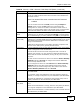
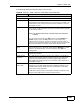
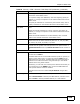
The following table describes the labels in this screen.
Table 69 Security > VPN > General > Rule Setup: IKE (Advanced)
LABEL DESCRIPTION
Property
Active Select this check box to activate this VPN policy.
Keep Alive Select this check box to have the NBG-460N automatically reinitiate
the SA after the SA lifetime times out, even if there is no traffic. The
remote IPSec router must also have keep alive enabled in order for
this feature to work.
NAT Traversal Select this check box to enable NAT traversal. NAT traversal allows
you to set up a VPN connection when there are NAT routers between
the two IPSec routers.
Note: The remote IPSec router must also have NAT traversal
enabled.
You can use NAT traversal with ESP protocol using Transport or
Tunnel mode, but not with AH protocol nor with manual key
management. In order for an IPSec router behind a NAT router to
receive an initiating IPSec packet, set the NAT router to forward UDP
ports 500 and 4500 to the IPSec router behind the NAT router.
IPSec Keying
Mode
Select IKE or Manual from the drop-down list box. IKE provides
more protection so it is generally recommended. Manual is a useful
option for troubleshooting if you have problems using IKE key
management.
Protocol Number Enter 1 for ICMP, 6 for TCP, 17 for UDP, etc. 0 is the default and
signifies any protocol.
Enable Replay
Detection
As a VPN setup is processing intensive, the system is vulnerable to
Denial of Service (DoS) attacks The IPSec receiver can detect and
reject old or duplicate packets to protect against replay attacks.
Select Yes from the drop-down menu to enable replay detection, or
select No to disable it.
DNS Server (for
IPSec VPN)
If there is a private DNS server that services the VPN, type its IP
address here. The NBG-460N assigns this additional DNS server to
the NBG-460N's DHCP clients that have IP addresses in this IPSec
rule's range of local addresses.
A DNS server allows clients on the VPN to find other computers and
servers on the VPN by their (private) domain names.